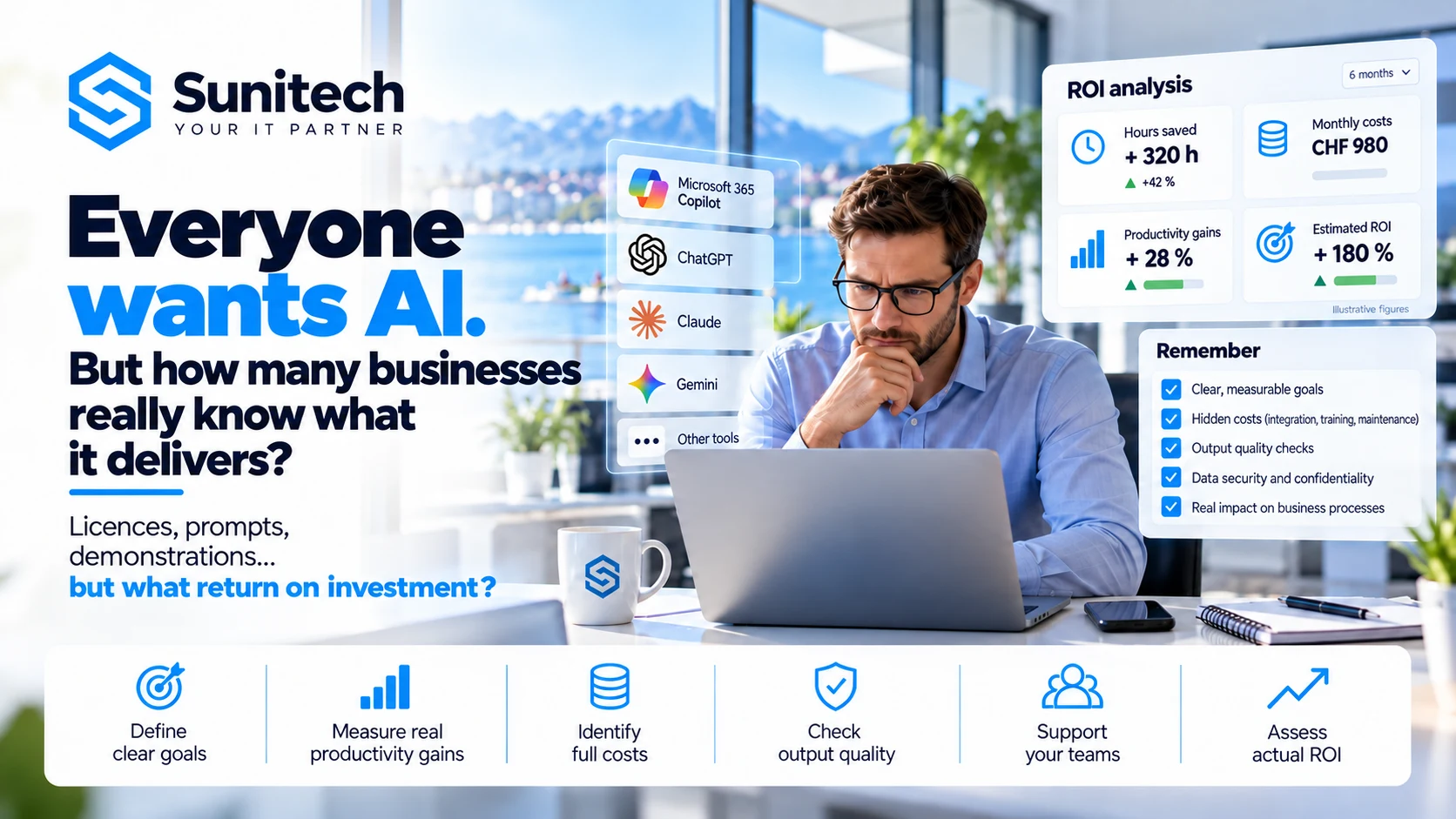

“We have deployed artificial intelligence in our business.”
Very good.
- But what has actually changed?
- How many hours have you really saved?
- Which processes have become more efficient?
- Which costs have you reduced?
- What improvement have your customers noticed?
- And above all, what is the return on investment of your project?
I find these questions much more interesting than the number of Copilot, ChatGPT or other artificial intelligence licences a business has purchased. Over the past few years, AI has become a fixture in businesses' strategic discussions. Everyone wants to adopt it. Everyone wants to automate. Everyone wants to improve productivity. And that is entirely understandable. The possibilities are considerable.
But installing an artificial intelligence tool does not, on its own, transform a business.
And paying for AI subscriptions every month does not necessarily mean those subscriptions create value.
AI has become a priority. Sometimes before the problem to solve has even been identified.
Imagine an SME with 30 employees. Management decides to equip several teams with an AI assistant. The stated objective: improve productivity. The licences are ordered. The accounts are activated. A presentation is organised to explain the features. Some employees start drafting their emails with AI. Others generate document summaries. Some use it occasionally to look for ideas. Six months later, management observes that the tool is being used. But one question remains:
What has the business actually gained?
The number of active users is known. The subscription costs are known. The number of requests made may also be known. Yet nobody has precisely measured the time saved, the quality achieved or the processes actually improved. This is an important confusion.
Using a tool is not a sufficient indicator of its profitability.
A tool can be popular without generating significant economic benefits. Conversely, a relatively discreet automation can deliver substantial value without being used directly by every employee.
Real return on investment is not measured by the number of prompts
We often discuss the productivity gains made possible by artificial intelligence. But three concepts need to be distinguished.
The theoretical time saving
An employee completes a task in five minutes instead of fifteen. They therefore appear to have saved ten minutes.
The time saving that can actually be used
The AI output may need to be reviewed, corrected, adapted or entered again in another system. The net gain may be smaller than the saving initially observed.
The economic or operational benefit
Even when an employee saves time, that saving does not automatically become a financial saving. It may allow more cases to be handled, shorter turnaround times, better service or more time for important tasks. These benefits have value. But they must be distinguished from an actual reduction in expenditure.
Take a simple example. An employee saves twenty minutes a day with an AI assistant. That represents about 7 hours a month over 21 working days. But if those hours are not used differently, it would be misleading to present them automatically as a financial saving equivalent to seven hours of salary.
Real ROI starts with understanding what the business actually does with the time it saves.
A worked example: when AI becomes genuinely worthwhile
Take a service-sector SME. It regularly handles customer requests, administrative documents and reports. It wants to automate part of the preparation of these documents. Before the project, each case requires an average of 25 minutes of processing. After an AI assistance system and human validation are introduced, the average falls to 12 minutes. The saving is 13 minutes per case. The business handles 400 cases a month. That represents:
400 × 13 minutes = 86.7 hours potentially freed up each month.
Assume a fully loaded internal cost of CHF 55 per hour. The freed-up working capacity represents a theoretical value of around CHF 4'767 a month. But be careful: this amount is not automatically a cash saving. To assess it properly, project-related expenditure must also be included. Imagine:
- CHF 450 a month for the use of AI tools and services.
- CHF 200 a month for operations and maintenance.
- CHF 500 a month of time spent on additional validation and corrections, if that time is not already included in the measured 12 minutes.
- CHF 6'000 for initial implementation.
Additional operating expenditure totals CHF 1'150 a month, on top of the initial investment. Over twelve months, the project costs CHF 19'800. The theoretical value of the freed-up capacity reaches around CHF 57'200 over the same period.
The potential looks interesting. But one decisive question remains: how much of those 86.7 monthly hours is actually turned into value for the business?
If only half of that capacity is actually reassigned to measurable productive activities, the economics look very different. That is why I recommend presenting several scenarios rather than an artificially optimistic ROI.
| Freed capacity redeployed | Theoretical capacity value | Value less project costs |
|---|---|---|
| 25 % | CHF 14'300 | CHF -5'500 |
| 50 % | CHF 28'600 | CHF +8'800 |
| 100 % | CHF 57'200 | CHF +37'400 |
Illustrative assumptions, not measured client results. The CHF 500 in extra checks is included only if it is outside the measured 12 minutes. Freed capacity is not automatically a cash saving.
The subscription amounts in section 4 and the 95% / 5% example in section 6 are illustrative, not current vendor prices or measured reliability statistics.
The hidden costs of AI are often underestimated
When a business compares artificial intelligence solutions, it generally looks at subscriptions. CHF 20, CHF 30 or CHF 40 per user per month. But the actual cost of an AI project can extend much further. In particular, consider:
Integration.
Connecting AI to business applications, databases, the CRM or internal documents may require development and configuration work.
Data preparation.
Incomplete, scattered or poorly structured data can considerably limit a solution's effectiveness.
Training.
Employees need to learn how to use the tools, understand their limitations and adapt their habits.
Human validation.
Some outputs must be checked before they are used.
Maintenance.
Workflows evolve, APIs change, models are updated and automations require monitoring.
Cybersecurity and compliance.
Access rights, information confidentiality, retention policies and processing terms must be examined.
Variable consumption.
Some services charge for data volumes, requests, tokens or computing resources.
Reversibility.
A deeply integrated solution can become difficult to replace.
A low-cost subscription can therefore conceal a relatively complex project. Conversely, a more expensive solution can be worthwhile if it delivers an important business outcome.
The price of an AI licence is not, on its own, enough to assess the cost of artificial intelligence for a business.
AI pilots that lead nowhere: a problem of method
A pilot project can be an excellent way to assess a technology. Provided you know what you are trying to demonstrate. Too often, projects start with very general objectives:
- “See what AI can do.”
- “Try Copilot.”
- “Automate certain tasks.”
- “Improve productivity.”
These intentions are understandable. But they are difficult to measure. An effective pilot should answer a concrete question. For example:
- Can we reduce the processing time for certain documents by 30% without increasing the error rate?
- Can we speed up the preparation of sales proposals while maintaining their quality?
- Can we reduce the volume of repetitive administrative requests handled manually?
- Can we improve response times for certain customer enquiries?
And above all:
Which results will allow us to decide whether to continue, modify or stop the project?
Without success criteria defined at the outset, it becomes too easy to call a pilot successful simply because a demonstration works. An impressive demonstration is not necessarily a reliable production process.
Quality control: the cost that demonstrations leave out
Generative artificial intelligence can produce convincing outputs. But convincing does not necessarily mean correct. A perfectly written text can contain incorrect information. A summary can omit an essential point. A technical answer can propose a solution that does not match the real context. An automation may work in 95% of cases and cause problems in the remaining 5%. In some processes, this level of reliability may be acceptable if appropriate checks are in place.
In others, it is insufficient. Take an example. AI makes it possible to prepare sales proposals faster. But if an employee must systematically reread every line, check prices, correct contractual terms and rephrase several elements, the actual saving may become small. That does not mean the tool is useless. It means the complete process must be measured.
An automation that produces errors quickly may simply move work elsewhere rather than remove it.
Quality must therefore be a success indicator alongside speed.
Not every process deserves to be automated
I consider this point particularly important. Just because a task can be automated does not mean it should be. A business can spend several weeks automating an operation that takes ten minutes a month. Technically, the project may be interesting. Economically, it may make no sense. I would first prioritise processes with several characteristics:
- They are repetitive.
- They consume a significant amount of time.
- They follow sufficiently stable rules.
- Their output can be checked.
- The necessary data is accessible and usable.
- Improving them delivers identifiable business value.
AI should also be compared with simpler solutions. Sometimes, traditional automation is enough. Sometimes, configuring existing software better solves the problem. And sometimes, changing a procedure delivers more value than adding an artificial intelligence model.
A good AI project starts with a business problem. Not with the choice of a model.
The five indicators I would track in an SME
To measure results, I would not start with a dashboard showing only the number of prompts or active accounts. Instead, I would track five indicators.
1. Actual processing time
How long does an operation take before and after AI is introduced, including quality control?
2. Full cost per operation
What is the actual cost of a case, request or processed document, including tools and human work?
3. Error and rework rate
How many outputs need correction? What are the consequences of errors?
4. Volume actually handled
Can the business absorb more requests or reduce an existing backlog?
5. Business value actually created
Do customers receive a faster response? Do teams accomplish more useful work? Do costs actually fall? Does quality improve?
These indicators must be compared with a baseline measured before deployment, allowing for differences in complexity and volumes. The aim is not to produce flattering figures. It is to determine whether the project deserves to continue.
The real purpose of AI is not always to reduce headcount
When productivity is discussed, some people immediately imagine job cuts. But that is not the only way to create value. In an SME, time is often a scarce resource. A business owner may be overwhelmed by administrative tasks. A sales team may lack the time to follow up prospects. A technical department may spend many hours documenting service work. A project manager may spend a significant part of the week producing reports.
If AI can reduce these tasks without compromising quality, the business can improve how it operates without necessarily reducing its workforce.
- It can handle more requests.
- Respond faster.
- Improve its documentation.
- Strengthen customer relationships.
- Spend more time on tasks that require human judgement.
But once again, these benefits need to be observed.
The return on investment of AI is not limited to salary savings. It can also be measured in capacity, quality and growth.
The role of management and the IT lead
AI is no longer solely an IT topic. It affects processes, data, skills, responsibilities and sometimes the company's business model. The IT lead's role is therefore not simply to provide access to tools. They must participate in evaluating solutions, securing data, controlling costs and integrating with existing systems. Management, for its part, must define the business objectives.
- Which problems does it want to solve?
- Which outcomes does it expect?
- What level of risk is acceptable?
- What budget is available?
- How will the benefits be measured?
Combining these skills is what turns a technical experiment into a useful project.
IT can make AI possible. But business strategy must give it a purpose.
The seven questions I would ask before investing in AI
Before signing up for new subscriptions or launching a project, I would ask these questions:
- 1. Exactly which business problem are we trying to solve?
- 2. How much time and money does this problem cost us today?
- 3. Why would artificial intelligence be preferable to traditional automation or a process improvement?
- 4. What will the full cost of the project be, beyond the licences alone?
- 5. How will we measure the benefits, accounting for errors and human checks?
- 6. How will we protect data and check the reliability of outputs?
- 7. Which criteria will let us decide whether to continue, adapt or stop the project?
If these questions remain unanswered, the business may not yet have an AI project. It has an intention to experiment. And that is not a problem, provided it acknowledges this and assigns an appropriate exploration budget.
Conclusion: AI does not need to be everywhere. It needs to be useful somewhere.
I am convinced that artificial intelligence can deliver important benefits to businesses. It already makes it possible to automate certain operations, improve access to information, accelerate document production and develop new services. But I also believe we need to move beyond the idea that adopting AI automatically means progress. A business can invest heavily in tools without really transforming its processes.
Conversely, an SME can achieve excellent results with a single well-designed automation. The difference is not only in the power of the model or the number of licences. It lies in understanding the need, the quality of integration and the ability to measure results.
The success of an AI project should not be measured by the number of employees using ChatGPT or Copilot.
It should be measured by what the business does better thanks to them.
Before asking “Which AI will we adopt?”, I believe management should start with a much simpler question:
“Which outcome do we want to improve, and how will we know we have succeeded?”
As the head of an IT services business, I believe our role is not to push the latest technologies systematically, but to help businesses make coherent, useful and measurable choices.
Artificial intelligence deserves more than impressive demonstrations and additional subscriptions. It deserves real objectives.
And you: does your business really measure the benefits of its AI projects, or is it still only measuring adoption?
#ArtificialIntelligence #SME #DigitalTransformation #Productivity #ROI